

Dussehra 2026: Date, Vijay Muhurat, Puja Vidhi and How to Worship Ram Darbar at Home
, by Vedansh Craft, 7 min reading time
Dussehra 2026 falls on October 20. Get the Vijay Muhurat, Shastra and Shami puja steps, and how to set up a brass Ram Darbar for puja at home.
Dussehra 2026: Date, Vijay Muhurat, Puja Vidhi and How to Worship Ram Darbar at Home
Dussehra, also called Vijayadashami, falls on Tuesday, October 20, 2026, the day after Navratri ends with Maha Navami on October 19. It celebrates the victory of Lord Rama over Ravana and of Goddess Durga over Mahishasura, and it is traditionally a day for new beginnings. This guide covers the date and Vijay Muhurat, the step by step Dussehra puja at home, a simple samagri checklist, and how to set up a brass Ram Darbar for worship, so you can keep the idol on your home altar long after the festival ends.
When is Dussehra 2026?
Dussehra 2026 is on Tuesday, October 20, 2026, on Ashwina Shukla Dashami. The Vijay Muhurat, the most auspicious window for the main puja, falls roughly between 2:00 PM and 2:45 PM in Delhi, within the wider Aparahna (afternoon) puja period of about 1:15 PM to 3:30 PM. Exact timings shift by city. The window starts around 1:15 PM in Kolkata and closer to 2:20 PM in Mumbai, so it is worth checking a local panchang for your area.
Why is Dussehra Celebrated?
Dussehra marks the triumph of good over evil, and two stories sit behind it. In the Ramayana, Lord Rama defeated the ten headed king Ravana after Ravana abducted Sita. In the Devi Mahatmya tradition, Goddess Durga defeated the buffalo demon Mahishasura after nine nights of battle, which is why Dussehra follows directly after Navratri. Rama's return to Ayodhya is then celebrated about three weeks later as Diwali.
How Dussehra is Celebrated Across India
- North and Central India: Ramlila performances end with the burning of large Ravana effigies at dusk, known as Ravan Dahan.
- West Bengal and Eastern India: Durga Puja concludes with idol immersion and Sindoor Khela on Vijayadashami.
- Maharashtra and parts of Central India: people exchange apta or shami leaves as symbolic gold.
- South India: Ayudha Puja, the worship of tools, books, and vehicles, is observed, and in Kerala children traditionally begin learning on this day in a ceremony called Vidyarambham.
- Karnataka: Mysuru Dasara is celebrated with grand royal processions.
Dussehra Puja Vidhi at Home: Step by Step
- Prepare the space. Clean the puja area, set up a raised platform, and place images or idols of Lord Rama and Goddess Durga.
- Begin in the Aparahna window. Start the main puja in the afternoon, ideally during the Vijay Muhurat.
- Shastra or Ayudha Puja. Place the tools you rely on, such as books, pens, instruments, or vehicle keys, on the altar and offer flowers and kumkum to thank them for the year's work.
- Shami Puja. Offer kumkum, akshat, and flowers to shami leaves, which are associated with victory and with the Pandavas' return from exile.
- Aparajita Puja. Worship Goddess Aparajita, the invincible form of Durga, with aparajita flowers, seeking success in the year ahead.
- Worship Ram Darbar. Offer flowers, a diya, and sweets to Rama, Sita, Lakshman, and Hanuman, and read a passage from the Ramayana or Ramcharitmanas.
- Evening aarti. Finish with aarti, and if you attend a Ramlila, watch the Ravan Dahan at dusk.
Dussehra Puja Samagri List
- Idols or pictures of Lord Rama, Sita, Lakshman, Hanuman, and Goddess Durga
- Shami leaves and aparajita flowers
- Akshat (unbroken rice), kumkum, and sandalwood paste
- Fresh flowers, preferably red or yellow
- A diya with ghee or oil, incense, and camphor
- Sweets or fruit for prasad
- Tools, books, or vehicle items for Shastra Puja
- A copy of the Ramayana or Ramcharitmanas
Setting Up a Brass Ram Darbar for Dussehra
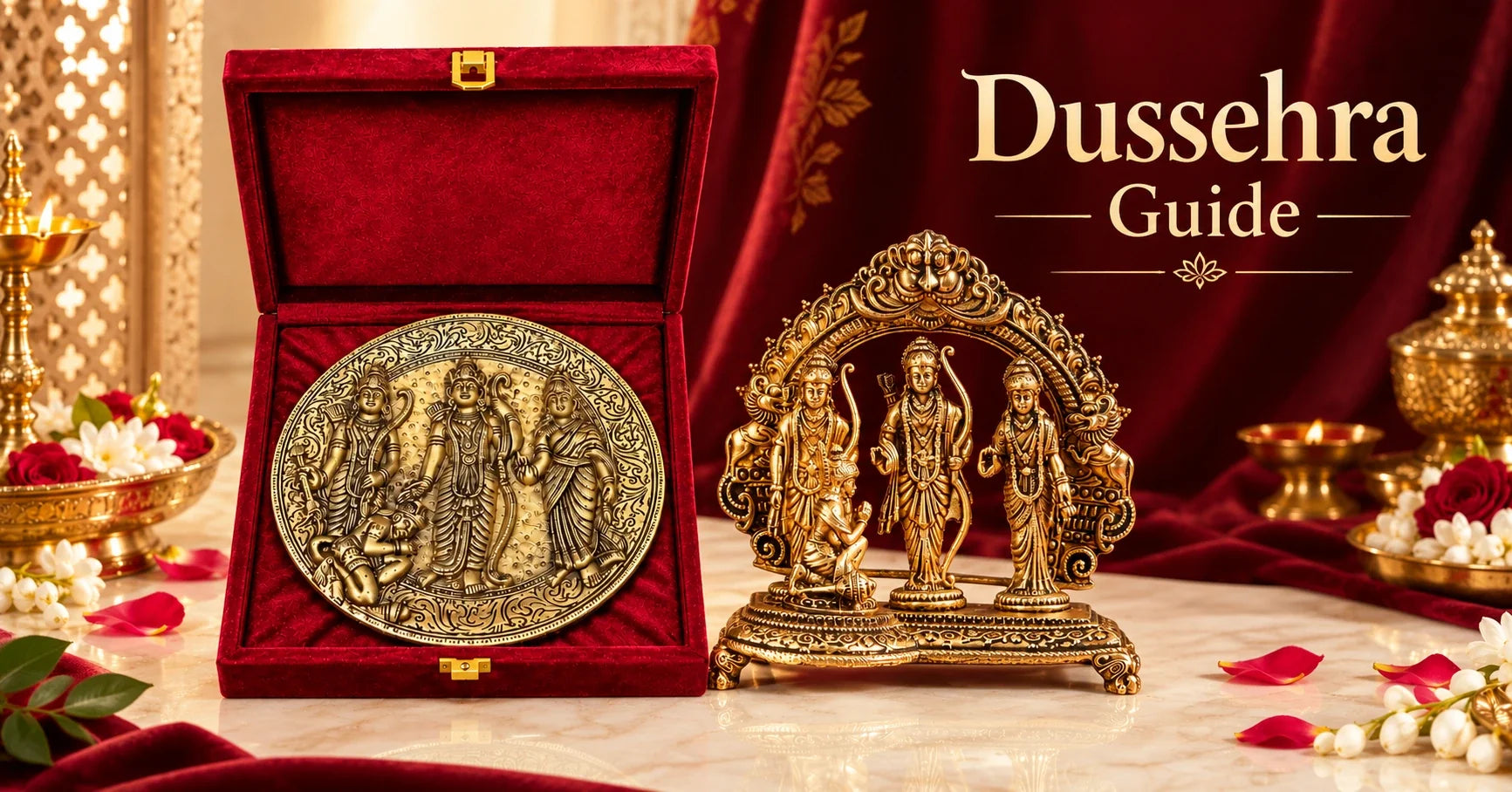
A Ram Darbar shows Lord Rama seated with Sita, Lakshman, and Hanuman, and it is considered an auspicious sight for a home altar because it represents a family built on devotion, duty, and loyalty. Unlike clay idols that are immersed, a brass Ram Darbar is installed once and worshipped daily, so Dussehra becomes the day you begin a practice that continues all year.
When choosing one, think about three things. Match the size to your altar, with 3 to 5 inch pieces suiting a small home mandir and larger sets working better in a dedicated puja room. Look for clear detailing in the faces, crowns, and Hanuman's folded hands. And prefer solid brass, which is heavier and develops a richer finish over the years. For a deeper walkthrough, read our guide on choosing the perfect Ram Darbar for your home decor.
Ram Darbar Pieces to Consider
- Brass Ram Darbar (3 Inch), a compact option for a small altar, available with a gift box.
- Brass Ram Darbar (4.5 Inch), one of our best sellers and a balanced size for most home mandirs.
- Brass Ram Darbar Statue (6.3 Inch), a larger piece with more visible detailing.
- Brass Ram Darbar Idol Set, four separate figures of Ram, Sita, Lakshman, and Hanuman for a larger altar.
- Brass Ram Darbar Wall Hanging Plate (8 Inch), for homes that prefer a wall mounted devotional piece.
- Brass Ram Darbar Door Lock with Three Brass Keys (4.5 Inch), a decorative touch for a puja room door.
If you also worshipped Goddess Durga through Navratri, our Navratri 2026 Durga idol guide covers how to keep a brass Durga idol on your altar year round.
From Dussehra to Diwali
Dussehra is also the start of the festive stretch that leads to Diwali, which falls on Sunday, November 8, 2026. Many families use the days in between to refresh the home altar, clean brass pieces, and plan new additions, so this is a natural moment to add an idol or diya before the Diwali rush begins.
Frequently Asked Questions
When is Dussehra in 2026?
Dussehra 2026 falls on Tuesday, October 20, 2026, the day after Navratri ends with Maha Navami on October 19.
What is the Vijay Muhurat for Dussehra 2026?
The Vijay Muhurat on October 20, 2026 falls roughly between 2:00 PM and 2:45 PM in Delhi, within the Aparahna puja window of about 1:15 PM to 3:30 PM. Timings vary by city.
Why is Dussehra celebrated?
Dussehra celebrates the victory of good over evil, marking Lord Rama's defeat of Ravana and Goddess Durga's defeat of Mahishasura.
What is Shastra Puja or Ayudha Puja on Dussehra?
Shastra or Ayudha Puja is the worship of tools, weapons, books, instruments, and vehicles. People place them on the altar, offer flowers and kumkum, and thank them for the year's work.
What is Ravan Dahan?
Ravan Dahan is the burning of large effigies of Ravana at dusk on Dussehra, mainly in North and Central India, symbolising the destruction of evil.
Can I keep a brass Ram Darbar at home permanently?
Yes. Brass idols are not immersed. A brass Ram Darbar is installed on the home altar and worshipped daily, making Dussehra a good day to begin that practice.
Tags
Blog posts